Food-Themed Sentence Tracing for Kids
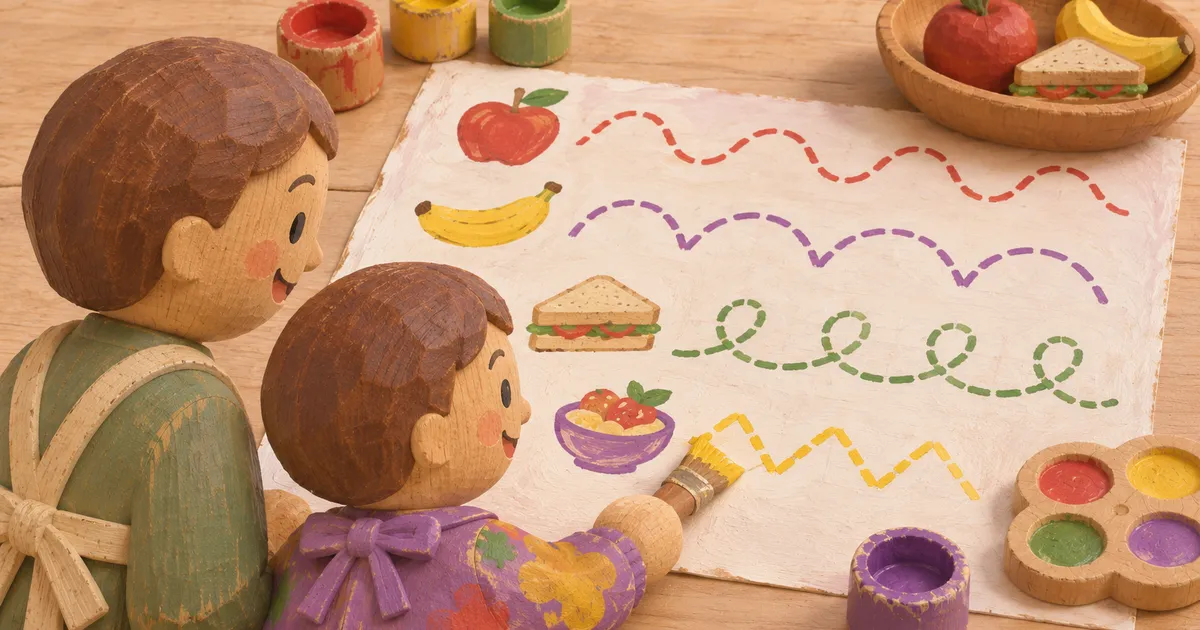
One food-themed tracing sentence combines three skills: handwriting, reading, and speaking. A child traces “I like apples,” reads it aloud, and connects the words with familiar food. Begin with one sentence in large dotted letters. Say it naturally, notice one target sound, and trace without turning the activity into a spelling test. Learners with stronger pencil control can copy the model, replace a food word, or add an adjective. This sequence links letter shapes, word order, meaning, and pronunciation.
What Families Need to Know
Tracing supports handwriting practice, but should not become a race. Ask your child to follow each letter from its starting point, leave visible spaces, and read the sentence after tracing. One careful line offers better practice than a crowded sheet completed without attention.
Food-themed sentence tracing for kids works best with familiar words. Show the real item, a package, or a picture when possible. Explain new vocabulary before writing. If the sentence says “The pear is ripe,” make sure your child knows both pear and ripe. Meaning gives the sentence purpose beyond copying marks.
How Tracing Connects Writing and Pronunciation
Tracing cannot teach pronunciation alone; the spoken model matters. Read the sentence at a natural pace, then repeat the target word slowly without stretching every sound. Your child listens, watches your mouth, says the word, and traces it. Finish by reading the full sentence with normal rhythm.
Choose one sound feature per sentence. In “I have an apple,” listen for the short vowel in apple. In “Cheese is yellow,” notice the first sound in cheese. In “We eat rice,” join the words smoothly instead of pausing after each one. During online lessons, LearnLink tutors can model these features while focusing on confident communication.
Accept consistent features of your family’s accent. British and American speakers may pronounce tomato differently: /təˈmɑːtəʊ/ and /təˈmeɪtoʊ/ are both established forms. Your child need not copy several accents at once. Pick one model, then explain that another form may be heard.
A Simple Routine for Home Practice
Prepare one to three sentences in large, pale, or dotted letters. Food-themed sentence tracing for kids can follow five steps: look at the food, listen, say the sentence, trace it, and read it again. Keep the paper still and provide a comfortable pencil. Stop when letter control or attention falls.
Correct selectively. If the goal is the first sound in fish, do not interrupt for every uneven letter. For spacing, point to one place where two words have joined and ask your child to repair it. Confident tracers can copy the sentence underneath or replace one food word.
Complete, Say, and Trace
Choose apple, bread, or rice to complete “I like ______.” Say the sentence, trace it once, then write it without the dotted model.
Examples for Different Ages and Stages
Age is a starting point, but handwriting control and English experience matter more. A multilingual child may understand a rich sentence while learning English letter patterns. Another may write neatly but need help forming a spoken sentence. Adjust the word count, line size, and speaking task separately.
Food-themed sentence tracing for kids should become less guided as control grows. Move from tracing a full sentence to difficult words, copying a model, and composing a new line. Older learners can compare flavours, explain preferences, or describe a family dish without presenting one cuisine as the default.
Practical Food and Sound Activities
Food-themed sentence tracing for kids becomes active when each sentence leads to a task. Place three foods or pictures on a table. Your child chooses one, traces “I can see a banana,” and points to the matching item. Then change the noun orally: “I can see an orange.” This checks understanding instead of copying.
Food Word Cards for Sentence Practice
Read each word, say the example, and choose one card for tracing.
I eat an apple.
The bread is soft.
I like cheese.
The fish is fresh.
We eat rice.
The soup is warm.
For sound sorting, choose contrasting words such as tea and cheese, or rice and fish. Say two words and ask whether their first sounds match. Do not rely on spelling: English letters do not always represent one sound. Keep the set small so your child can hear and repeat each item accurately.
Build a Food Sentence
Complete “The ______ is ______” with a food and an adjective, such as “The lemon is sour.” Say the sentence twice, trace it, and underline the food word.
Tongue twisters add playful pronunciation practice, but accuracy comes before speed. Try “Fresh fish for Friday” or “Ten tiny tomatoes.” Say the line in two parts, join them, and trace it once. If sounds blur, slow down. One controlled repetition beats rushed attempts.
Change the Meaning
Trace “I like sweet pears.” Replace sweet with soft, green, or ripe. Read each sentence aloud and explain how the adjective changes its meaning.
- Try food-themed sentence tracing for kids aged five to seven after breakfast.
- Use six food picture cards and say each initial sound aloud together.
- Trace three short food sentences, tapping once for every spoken word.
- Practice matching apple, banana, milk, and rice with their beginning sounds.
- Finish by reading one favorite food book and repeating rhyming words.
When a word has several meanings or pronunciations, Cambridge Dictionary is a useful check before turning it into child-friendly examples.
Frequently Asked Questions
How Long Should a Sentence-tracing Activity Take?
A brief session usually supports one goal. Choose one to three sentences and stop before grip, posture, or attention declines. A younger beginner may trace one line. An older child may trace, copy, and adapt several sentences. Letter formation, spacing, reading, and speech matter more than completed pages.
Can Sentence Tracing Improve Pronunciation?
Food-themed sentence tracing for kids can support pronunciation when each written sentence has a spoken model. Let your child listen before reading, focus on one sound or rhythm feature, and say the full line after tracing. Tracing cannot show how a word sounds, so do not ask your child to infer pronunciation from English spelling.
Should We Use British or American Pronunciation?
Either variety provides a consistent model. Use the form your child hears most at school, home, or in lessons. Mention common differences, such as the two established pronunciations of tomato, without asking your child to switch accents during one activity. The goal is understandable speech, not removing a family or regional accent.
What If My Child Can Say the Sentence but Struggles to Trace It?
Separate language from handwriting. Let your child say the sentence, trace it with a finger, then use a pencil. Increase the letter size or shorten the sentence when needed. You can trace one word and let your child choose the matching food picture. Spoken English and pencil control may progress at different rates.
- Start with one familiar sentence and one clear handwriting goal.
- Practice the spoken model before your child picks up a pencil.
- Finish by reading the traced sentence aloud and changing one word.
Start your child's English journey today — book a trial lesson with LearnLink.
Stay updated on our latest tips and resources by following us on Instagram LearnLink.