English Words About Ancient Egypt for Kids
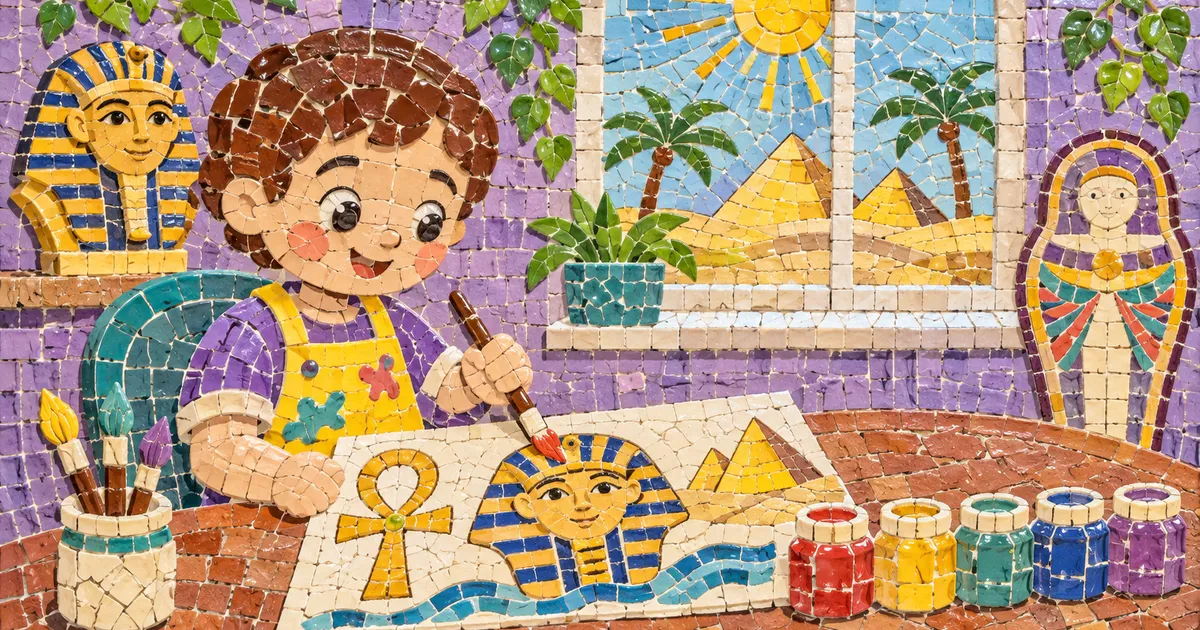
Ancient Egypt Words in English for Kids: Vocabulary and Activities presents 32 terms about people, places, objects, and daily life. Children can start with concrete words such as pyramid, boat, and crown, then learn scribe and hieroglyph. The goal is to understand English, pronounce each word, and build short sentences. The activities suit different ages, multilingual children, and beginners taking online English lessons.
📥 Ancient Egypt Word Quest
Learn, match, and use essential English words from the world of pharaohs and pyramids.
Leave your email — we'll send the PDF to your inbox.No spam — the PDF plus one short reminder. Unsubscribe anytime.
Key Vocabulary for an Ancient Egypt Lesson
Start with words a child can see or act out. The table groups 32 English words into eight sets. Study one set, connect each word to an image or action, and review it later that week.
For a first lesson, Ancient Egypt Words in English for Kids: Vocabulary and Activities works in small sets. A five-year-old might learn pyramid, boat, crown, and crocodile. An older child can add sarcophagus, artisan, and delta. Define each term in plain English: a scribe wrote documents, an artisan made skilled objects, and a sarcophagus was a stone coffin.
Useful Phrases and Sentences in Context
Words stick when joined to short phrases. In Ancient Egypt Words in English for Kids: Vocabulary and Activities, pair nouns with verbs and adjectives: build a pyramid, write on papyrus, sail on the Nile, wear a crown, grow grain, and carve a statue. Children can reuse these combinations.
Next, practise sentences: “The scribe writes on papyrus.” “A boat sails along the Nile.” “The farmer grows grain.” “The pharaoh wears a crown.” “The crocodile lives near the river.” For past-time practice, change the verbs: “Artisans made statues,” or “Farmers grew crops.” Explain that seasonal Nile flooding supported ancient farming; modern river life does not work identically.
Questions turn recognition into speech. Ask, “Who writes on papyrus?”, “Where is the boat?”, or “Which object would an artisan make?” A younger child may give one word. An older learner can answer fully and explain: “I chose the amulet because it is a small object that people wore or carried.”
How to Introduce the Words Step by Step
Begin with four to six picture cards. Say each word at natural speed, then let your child point, repeat, and match. Place pharaoh beside a ruler’s image and papyrus beside writing material. Accurate pictures connect each English label to the correct idea.
Next, sort the cards into people, places, objects, and nature. Sorting adds meaning without lengthy explanations. In multilingual families, invite your child to name an object in another language, then return to its English word and sentence. Existing knowledge supports English practice.
Finish with recall instead of rereading. Turn the cards face down and give a clue: “This person wrote records,” or “This is a long river in Egypt.” Across LearnLink lessons, our tutors can adjust clue numbers, sentence length, and speaking demands for children aged 4–15.
Activities for Different Ages
Ancient Egypt Words in English for Kids: Vocabulary and Activities should develop with children’s reading skills and background knowledge. Younger learners need movement and visual support. Older learners can compare meanings, cite evidence, and write connected sentences.
Link history with language without making every session a fact test. A child may understand mummy but need help forming the plural mummies. Another may know the history in French, Spanish, Hebrew, or another home language but need time to form an English sentence. Treat that knowledge as a strength.
Practice Games for Home or Class
Play “mystery object” for speaking practice. Put six word cards on a table and give clues without naming the answer: “It is made of stone. It can hold a coffin. It is linked to burial.” Your child chooses sarcophagus and identifies the decisive clue. Swap roles so the child selects precise describing words.
Build an Ancient Egypt Sentence
Choose one word from each group: person, action, and object or place. Try “The scribe writes on papyrus,” “The farmer sails on the river,” or “The artisan carves a statue.” Then change the time: “The artisan carved a statue.” Check whether the new sentence still makes sense.
Short reviews beat one long drill. Practise six words today, recall them tomorrow without looking, and revisit them days later. Mix old and new cards to prevent guessing from the latest set. End with a question your child answers confidently, creating momentum for the next session.
Common Language and History Mistakes
Capital letters often cause errors. Write Egypt, Egyptian, Ancient Egypt, and the Nile with capitals. Nouns such as pharaoh, pyramid, and mummy usually start with a lower-case letter unless beginning a sentence. Use Egyptian for a person, object, or custom from Egypt; use Egypt for the country.
Check plural forms. One mummy becomes two mummies; one hieroglyph becomes multiple hieroglyphs. A hieroglyph is one sign; hieroglyphs form the writing system. Papyrus can mean the plant or its writing material, so the sentence determines the meaning.
Correct historical shortcuts alongside grammar. Not every ancient Egyptian was a pharaoh, not every mummy was a ruler, and pyramids were not ordinary homes. Ancient Egypt Words in English for Kids: Vocabulary and Activities should build practical language without reducing a rich society to costumes and monuments.
- Try asking children ages seven to ten to correct three anachronistic Egyptian sentences.
- Use a picture book to separate hieroglyphs, spoken language, and modern English terms.
- Practice matching five Ancient Egypt words with accurate objects instead of stereotypes.
- Check one museum website together before repeating claims about pyramids or pharaohs.
- Ask your eight-year-old to explain one correction using evidence from two pictures.
When a word has several meanings or pronunciations, Cambridge Dictionary is a useful check before turning it into child-friendly examples.
Frequently Asked Questions
How Many Ancient Egypt Words Should My Child Learn at Once?
Begin with four to six words for a young beginner. A confident reader may handle eight to ten related terms. Ancient Egypt Words in English for Kids: Vocabulary and Activities includes 32 words, but not for one sitting. Teach one group, practise sentences, and add another when your child recalls most words without the list.
Does My Child Need to Know Egyptian History First?
No. A picture and plain definition provide enough context. Explain only the word: a scribe wrote records, while papyrus served as writing material. When curiosity grows, add short details from a reliable museum or school resource. Language practice can introduce history before a full history unit.
What Should I Do When a Word Is Hard to Pronounce?
Break the word into manageable parts, say it slowly, then return to normal speech. Let your child listen before repeating. Put the word in a short phrase; rhythm helps with long terms. Do not interrupt every sentence. Practise one sound, model it calmly, and continue the conversation to keep meaning central.
Can a Multilingual Child Learn These Words Through Another Home Language?
Yes. Link the English term briefly to a known word. Your child can label a picture in two or three languages, then use English during the matching game or sentence task. Another language is an asset, not an error or barrier. The goal is to connect a new English form with an understood idea.
- Start with four to six concrete words and match each one to a clear picture.
- Practice each word in a short phrase, then ask your child to build a complete sentence.
- Try a recall game the next day and revisit difficult words later in the week.
If your child needs steady speaking practice, start small — choose a trial lesson.
Stay updated on our latest tips and resources by following us on Instagram LearnLink.